
Window tinting cost in Phoenix, AZ depends on the film, the vehicle, and the prep work behind the install. Valley drivers often see quotes that differ by hundreds of dollars for the same car. Apex Autowerks explains what drives those gaps so buyers can compare offers clearly. The shop’s window tint services in Phoenix page lists its packages and film options.
Table of Contents
- How Much Does Window Tinting Cost in Phoenix, AZ in 2026?
- What Is the Difference Between Film Cost and Total Installation Cost?
- What Factors Change the Price of Car Window Tint?
- How Much More Does Ceramic Tint Cost Than Carbon Film?
- How Do Sedan, Coupe, SUV, Truck, and Tesla Layouts Change the Price?
- How Much Do Front Windows, Rear Sides, Full-Car Tint, and a Visor Strip Cost?
- What Does Arizona Tint Law Mean for Shade Choice and Pricing?
- How Do Phoenix Heat and West Valley Driving Affect Film Choice?
- What Should Drivers Compare When Reviewing Window Tint Quotes in Phoenix?
- Conclusion
How Much Does Window Tinting Cost in Phoenix, AZ in 2026?
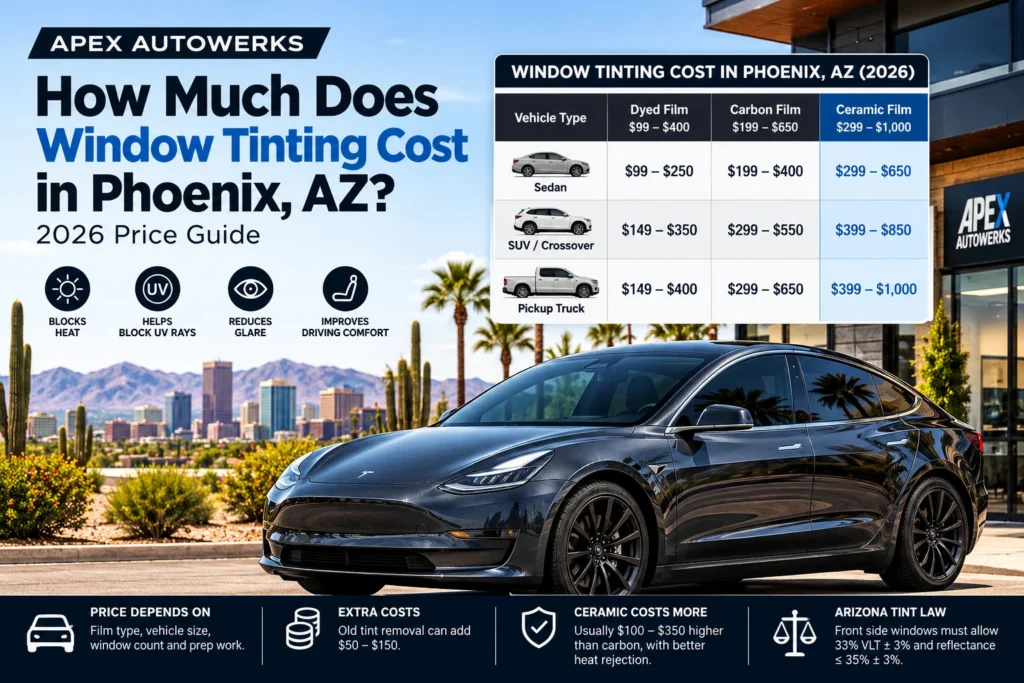
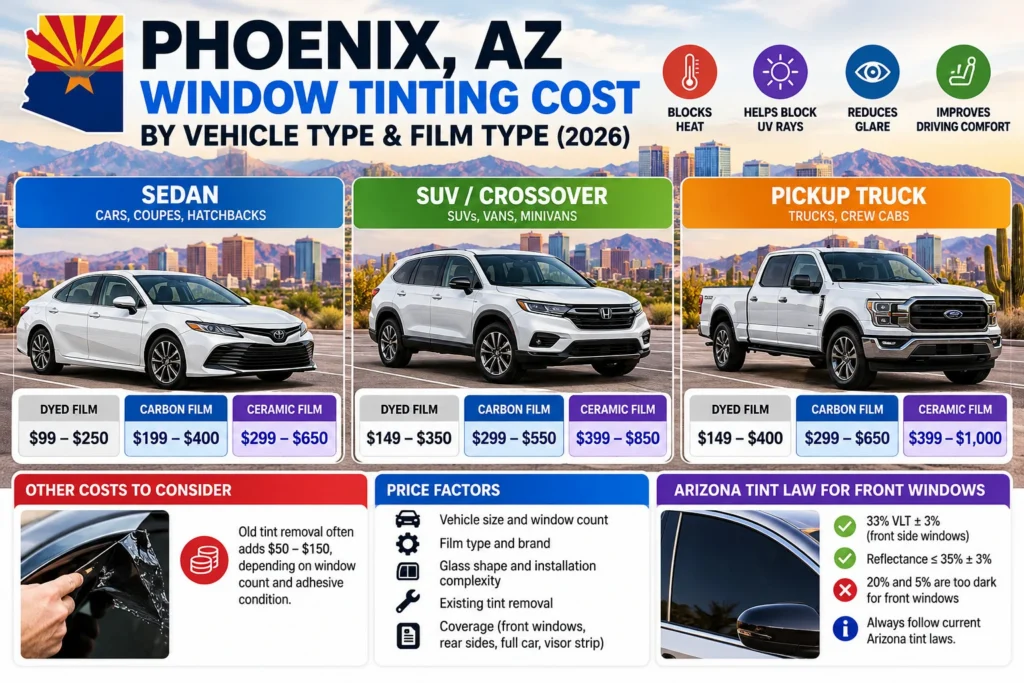
Most Phoenix-area shops price tint by quote, not by flat rate. Full-car tint commonly runs from under $200 for dyed film. Ceramic on a larger vehicle can pass $600. Final totals depend on film, vehicle, and coverage.
The ranges below come from 2026 pricing guides published by Phoenix-area shops and a Phoenix directory. They are market references, not prices from the shop in this guide. The sources disagree in places, so each range is widened to cover them.
| Film Type | Sedan | SUV or Crossover | Pickup Truck |
|---|---|---|---|
| Dyed | $99 to $250 | $149 to $350 | $149 to $400 |
| Carbon | $199 to $400 | $299 to $550 | $299 to $650 |
| Ceramic | $299 to $650 | $399 to $850 | $399 to $1,000 |
Crew cabs, rear sliders, and glass roofs push totals toward the top of each band. Ranges assume standard coverage with no old film to remove.
What Is the Difference Between Film Cost and Total Installation Cost?
Film cost is the material. Roll price depends on the film technology, the brand, and how much glass the vehicle has. Ceramic film generally costs more than carbon, and carbon costs more than dyed.
Total installation cost adds the labor behind the film. Apex Autowerks follows five steps at its West Phoenix shop. They are glass cleaning, film cutting, application, heat forming on curved glass, and a final check. Careful prep and edge work take time, which is why labor is a large part of every quote.
A low total can hide thinner film, rushed prep, or a limited warranty. Comparing film price alone misses those differences. The full scope of work should sit beside the number.
What Factors Change the Price of Car Window Tint?
Vehicle Size, Window Count, and Glass Design
Small sedans have fewer and smaller panes, so they sit near the low end of each band. SUVs and vans add quarter glass and large cargo windows. Sharply curved rear glass and hatchbacks add labor because each piece must be shaped to fit.
Existing Tint Removal
Old film must come off before new film goes on, because new film needs bare, clean glass. One Phoenix-area guide adds roughly $50 to $150 for removal, depending on window count and adhesive. Factory-tinted glass needs no removal.
Installation Complexity
Heat forming, edge finishing around seals, and working around defroster lines all take time. Tight glass shapes slow the job more than flat door glass. More labor hours raise the total even when the film is identical.
How Much More Does Ceramic Tint Cost Than Carbon Film?
Ceramic usually costs more upfront than carbon because of how it is made. Apex Autowerks installs only ceramic and carbon film. Ceramic uses nonmetallic ceramic particles that target infrared light, while carbon uses carbon particles for a matte, deep finish.
In the table above, ceramic runs roughly $100 to $350 higher than carbon at the top of each band. That premium pays for technology aimed at heat control. It does not guarantee a specific result, because performance varies by film line, shade, and vehicle.
Heat figures deserve a closer look before buying. The shop’s own guidance points to total solar energy rejected, known as TSER, as the main heat number to compare. Buyers can ask the installer for the manufacturer’s published specifications on the exact film quoted.
How Do Sedan, Coupe, SUV, Truck, and Tesla Layouts Change the Price?
Sedans are the usual baseline, and larger bodies cost more. Coupes are not always cheaper, since long doors and curved rear glass add labor. One directory lists coupes above sedans for the same film.
| Vehicle Type | Typical Effect on Price | Reason |
|---|---|---|
| Sedan | Baseline | Four door windows plus one rear window |
| Coupe | Similar to or above a sedan | Large doors and curved rear glass |
| SUV or crossover | Higher | Quarter glass and a large cargo window |
| Pickup truck | Wide range | Crew cabs and rear sliders cost more |
| Tesla | Higher in many cases | Glass roofs and model-specific side glass |
Tesla Model 3 and Model Y have single-pane side glass. Model S and Model X have double-pane front door glass from 2021. Model Y and Model X also carry wide glass roofs. The shop’s four packages do not cover glass roofs, so roof film is quoted separately. One Phoenix-area guide adds $50 to $100 for panoramic roofs. Totals vary by shop. Tesla owners can see how each of the four packages fits a Tesla’s glass on the shop’s Tesla tint packages page.
Phoenix drivers choosing between ceramic and carbon can call (602) 857-9929 with the year, make, and model. A written quote can price front-two, full-car, and visor strip packages for sedans, trucks, and Teslas, with removal listed as its own line item.
How Much Do Front Windows, Rear Sides, Full-Car Tint, and a Visor Strip Cost?
The shop offers four coverage choices, and ceramic or carbon film applies to any of them. No Phoenix source publishes reliable stand-alone prices for each package, so the table describes coverage and what to confirm. Totals depend on the vehicle and film chosen.
| Coverage | What It Covers | Pricing Note |
|---|---|---|
| Front Two | Front door windows only | Usually the lowest-cost entry point |
| Rear Sides | Rear door windows and rear glass, including curved hatchback glass | Priced by window count and glass curve |
| Full Car | Front doors, rear doors, and rear glass, including quarter glass | Front and rear shades can differ |
| Windshield Visor Strip | One strip in the legal top band | Quoted separately by most shops |
A sunroof is also quoted on top of a package. One Phoenix directory puts sunroof or specialty glass at $100 to $300 extra. Ordering the front windows first and adding rear glass later spreads cost across two visits.
What Does Arizona Tint Law Mean for Shade Choice and Pricing?
Arizona Revised Statutes section 28-959.01 sets the front side window limit at 33 percent light transmission, plus or minus 3 percent. Reflectance is capped at 35 percent, plus or minus 3 percent. Factory glass counts toward that limit, so a film near 33 percent can leave a window darker than allowed.
Side windows behind the driver are exempt from the darkness limit. A rear window qualifies with the reflectance cap or with outside mirrors on both sides showing 200 feet back. Windshield material is allowed only in a top band. Its lower edge must sit 29 inches above the seat, and it cannot be red or amber.
Shade affects legality more than price, since film type and coverage set the cost. A medical exemption exists for drivers who need sun shielding, with a physician’s written attestation. Final compliance depends on the vehicle and the film’s measured light transmission. Shade choices should be confirmed with the installer and the current statute.
How Do Phoenix Heat and West Valley Driving Affect Film Choice?
Triple-digit summer afternoons make a parked car in Phoenix a heat trap. Drivers in West Phoenix, Avondale, Goodyear, Laveen, and Buckeye often park outdoors at work sites, schools, and shopping centers. That exposure is why many weigh ceramic against carbon.
The shop describes tint as reducing how much sunlight warms the cabin. That can leave the air conditioning less to catch up on after a car sits in the sun. Ceramic suits owners who spend long hours in the car or keep it for years. Carbon fits buyers who want a matte look and solid everyday comfort at a lower price.
Darkness has trade-offs beyond heat. Darker film cuts visibility after dark, especially through rear glass when reversing. Buyers who commute on the I-10 or Loop 101 at night should weigh that against privacy.
What Should Drivers Compare When Reviewing Window Tint Quotes in Phoenix?
Two quotes with the same total can describe different films, coverage, and terms. A written quote should name each item in the table. The last column gives a question to ask.
| What to Compare | Why It Matters | Question to Ask |
|---|---|---|
| Film type and line | Sets heat control and most of the price | Which exact film and shade is quoted? |
| Windows covered | Front, rear, quarter glass, roof, and strip are priced separately | Which panes are included? |
| Old tint removal | Adds labor before installation | Is removal included or extra? |
| Warranty terms | Coverage wording varies between shops | What does it cover, and does it transfer with the car? |
| Shade and Arizona limits | Noncompliant tint can mean a correction order | Does this shade meet the front window limit? |
| Install setting | Dust and heat affect finish quality | Is the work done in a shop? |
| Total price | Extras change the final bill | Is this the out-the-door total? |
The shop says a lifetime warranty is available with its window tint installations. It also notes that terms can vary, so owners should ask what a specific install covers and keep that record.
Conclusion
Window tinting cost in Phoenix comes down to film type, vehicle size, glass shape, coverage, and old film removal. Dyed film costs least, carbon sits in the middle, and ceramic costs most upfront. Market ranges help with budgeting, but only a quote for the exact vehicle gives a real total.
Apex Autowerks quotes ceramic and carbon tint by year, make, and model from its West Phoenix shop. Buyers weighing the higher-cost option can read about ceramic window tinting in Phoenix before choosing a film.
Apex Autowerks at 2885 N 91st Ave in West Phoenix can scope a tint budget for a specific vehicle. Call (602) 857-9929 or submit the quote form on the website with the year, make, and model to receive a priced plan for the exact film and coverage selected.
Frequently Asked Questions
Phoenix-area guides show sedans from about $99 for dyed film to $650 for ceramic, with SUVs and trucks higher, up to roughly $1,000 for ceramic on a large truck. Shops quote by film, vehicle, and coverage, so a written quote for the exact car gives the real total price before booking.
Ceramic costs more upfront than carbon or dyed film because it is built to target infrared light. It suits drivers who spend long hours in the car or keep it for years, while carbon fits tighter budgets. Ask the installer for the manufacturer’s published specs on the exact film quoted.
Tesla tint often costs more because of glass roofs and model-specific side glass. One Phoenix guide lists Teslas from $399 for entry-level film, and another adds $50 to $100 for panoramic roofs. Roof film is usually quoted separately, so send the model, year, and windows requested.
Yes, removal is typically a separate labor line. One Phoenix-area guide lists roughly $50 to $150, depending on window count and how much adhesive remains. Factory tint needs no removal, so mention any aftermarket film when requesting a quote and confirm removal is priced in the quote.
Arizona requires front side windows to allow at least 33 percent visible light, plus or minus 3 percent, with reflectance capped near 35 percent. Windows behind the driver have no minimum. Factory glass counts toward the limit, so confirm the shade with the installer and the current statute.
Quotes differ because film line, coverage, removal, and warranty terms differ. One shop may price only the front windows with dyed film while another prices every window with ceramic and a visor strip. Comparing the written scope of each quote, not just the total, shows what is priced.