
Arizona window tint laws set separate limits for front windows, rear glass, and the windshield. Drivers across Phoenix and the West Valley often ask which film is legal before booking an install.
This guide from Apex Autowerks, a West Phoenix tint shop, uses the current statute text. It covers every window, reflectivity, colors, medical exemptions, and common shade questions.
Table of Contents
- What Are the Arizona Window Tint Laws at a Glance?
- What Does Visible Light Transmission Mean in Arizona?
- How Dark Can Front Side Windows Be in Arizona?
- What Are the Rules for Rear Side Windows and the Rear Window?
- What Are the Windshield Tint Rules in Arizona?
- Does Arizona Limit Tint Reflectivity and Colors?
- How Is Factory Privacy Glass Different From Aftermarket Tint?
- Do Arizona Tint Laws Differ for Cars, SUVs, Trucks and Vans?
- How Does a Medical Tint Exemption Work in Arizona?
- Who Certifies Tint, and What Happens If Tint Is Too Dark?
- Is 70%, 50%, 35%, 20% or 5% Tint Legal in Arizona?
- Conclusion
What Are the Arizona Window Tint Laws at a Glance?
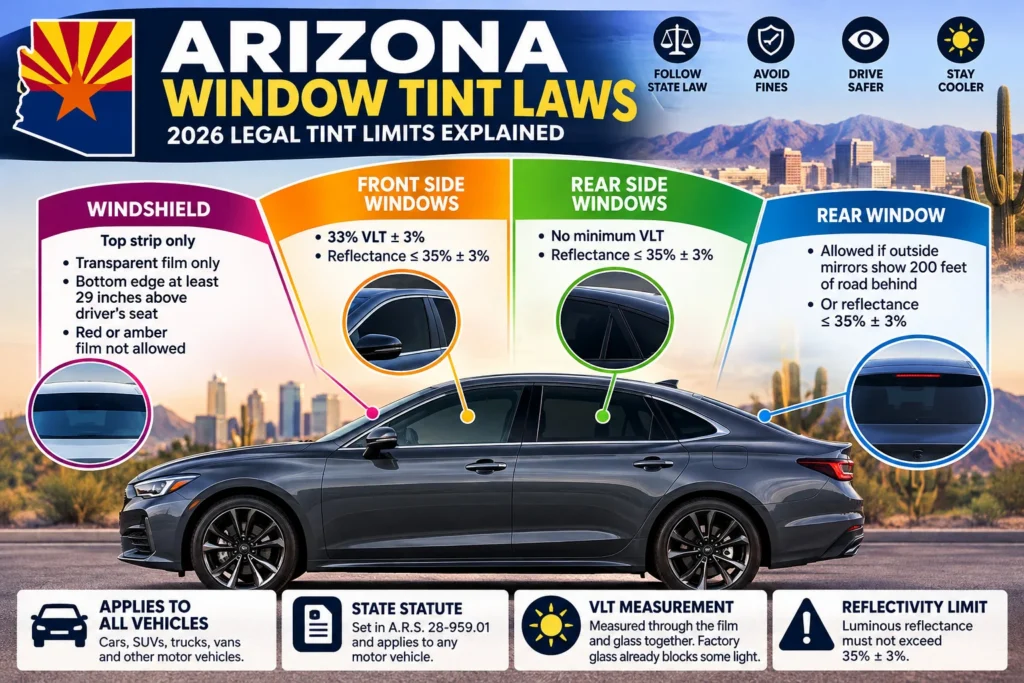
Arizona sets its window tint rules in A.R.S. 28-959.01, and the section applies to any motor vehicle. The limits change by window, so front side glass, rear glass and the windshield each follow a different rule.
| Window | What Arizona law allows |
|---|---|
| Windshield | Transparent film on the topmost strip only. The bottom edge must sit at least 29 inches above the undepressed driver’s seat. Red and amber film are not allowed. |
| Front side windows | Light transmission of 33%, plus or minus 3%. Luminous reflectance of 35%, plus or minus 3%. |
| Rear side windows | No minimum light transmission. Luminous reflectance of 35%, plus or minus 3%, or lower. |
| Rear window | Allowed when outside mirrors on both sides show 200 feet of road behind, or when reflectance is 35%, plus or minus 3%, or lower. |
What Does Visible Light Transmission Mean in Arizona?
Visible light transmission, or VLT, is the share of visible light that passes through a window. A 33% reading means one-third of outside light gets through, and a lower number means darker glass.
Arizona measures light through the film and the glass together. Factory glass already blocks some light. A 35% film on a front window can read darker than 35% once installed.
Front window shades at Apex Autowerks come from the range Arizona allows. The statute states the 33% limit with a tolerance of plus or minus 3 points.
How Dark Can Front Side Windows Be in Arizona?
Front side windows must allow 33% of light, plus or minus 3%, with reflectance capped near 35%. Arizona news reports describe the rule as letting in at least 33% of light. That makes 35%, 50% and 70% film workable and 20% and 5% film too dark up front.
Film rated at 35% still needs a final reading, because factory glass lowers the number. Drivers who want a darker look can tint the rear windows instead, as the next section explains.
The shop’s window tint packages in Phoenix can start with the two front doors. Front shade is chosen from the range Arizona allows.
What Are the Rules for Rear Side Windows and the Rear Window?
Arizona sets no minimum light transmission for side windows behind the driver. Reflectance for those windows must stay at 35%, plus or minus 3%, or lower. That is why 20% and 5% film are legal on rear doors.
The rear window is allowed when outside mirrors on both sides show 200 feet of road behind the vehicle. It also qualifies when reflectance stays at 35%, plus or minus 3%, or lower.
Rear Sides installs at Apex Autowerks cover each rear door window, small quarter glass and the rear window. Drivers from Phoenix, Goodyear, Avondale, Laveen and Buckeye can book that package.
What Are the Windshield Tint Rules in Arizona?
Arizona allows transparent film only on the topmost part of the windshield. The bottom edge must sit 29 inches or more above the driver’s seat, and red or amber film is banned. Safety monitoring equipment may be mounted behind, slightly above or slightly below the rearview mirror.
Many drivers call this limit the AS-1 line, a marking near the top of the glass. The statute itself uses the 29-inch measurement. A shop should confirm the strip height on each windshield.
Signs and stickers have limited spots on the glass. A 7-inch square is allowed in the lower corner farthest from the driver. A 5 inch square is allowed in the lower corner nearest the driver.
Choosing a legal shade for a Phoenix car depends on the factory glass already on it. Call (602) 857-9929 to talk through film shades that fit Arizona’s tint limits, then get a priced plan for front two, rear sides or full car tint on that exact vehicle.
Does Arizona Limit Tint Reflectivity and Colors?
Luminous reflectance is the share of light that bounces outward off the glass. Arizona caps it at 35%, plus or minus 3%, on front side windows, rear side windows and the rear window. Highly mirrored film is the type most likely to exceed that cap.
The statute names red and amber as barred colors on the windshield strip. It does not list other restricted colors by name. Drivers considering unusual film colors should ask the installer for the reflectance and transmission specs first.
How Is Factory Privacy Glass Different From Aftermarket Tint?
Factory privacy glass is dyed during manufacturing, so the darkness sits inside the glass itself. Many SUVs, vans and trucks use it on rear windows. Aftermarket tint is film applied to the glass after the vehicle is built.
Arizona’s statute regulates material placed, affixed or applied to windows. Film added over factory glass falls under the rule, and its final reading includes the glass beneath.
Adding film over privacy glass on rear windows follows the rear glass rules covered earlier. Front windows keep the 33% limit, even on vehicles with dark factory glass behind the driver.
Do Arizona Tint Laws Differ for Cars, SUVs, Trucks and Vans?
The statute text applies one set of tint rules to every motor vehicle. It does not create separate darkness limits for cars, SUVs, trucks or vans. Arizona’s section does not split limits by vehicle class.
Vans and SUVs often have extra side glass behind the driver. All of it follows the rear side rule. Pickups have a rear window that must meet the mirror or reflectance conditions.
How Does a Medical Tint Exemption Work in Arizona?
Arizona allows a medical exemption for people who must be shielded from direct sunlight. The application is ADOT Form 40-1511, certified by an MD, DO, naturopathic doctor or ophthalmologist. The completed form goes to the ADOT Medical Review Program.
The exemption covers vehicles the person owns and vehicles where the person is a regular passenger. ADOT requires a certificate in each vehicle owned. The statute allows changes to side and rear windows under an exemption.
Anyone planning darker film should finish the exemption first. ADOT Medical Review takes questions at 602.771.2460 on weekdays.
Who Certifies Tint, and What Happens If Tint Is Too Dark?
Under A.R.S. 28-959.01, manufacturers must certify to the director that their film meets the reflectivity and transmittance rules. Installers must state in a conspicuous manner that side window film may be illegal in some states.
The statute text sets no sticker, decal or inspection step for vehicle owners. Exemption holders are the exception, since ADOT requires a certificate in each vehicle.
ADOT states that operating a vehicle without meeting the tint requirements violates the law. In 2022, Arizona DPS told KJZZ that dark front windows and film below the AS-1 line draw most stops. Drivers may receive a repair order or a citation.
Is 70%, 50%, 35%, 20% or 5% Tint Legal in Arizona?
| Tint Level | Front Side Windows | Rear Side Windows | Rear Window |
|---|---|---|---|
| 70% | Legal | Legal | Legal |
| 50% | Legal | Legal | Legal |
| 35% | Legal after the final reading is checked with the glass | Legal | Legal |
| 20% | Not legal | Legal | Legal when the mirror or reflectance rule is met |
| 5% | Not legal | Legal | Legal when the mirror or reflectance rule is met |
Reflectance limits apply to every window in the table. On the windshield, film belongs in the top strip only, so none of these percentages are allowed below it. Film labeled with a percentage should always be confirmed with the final reading through the glass.
Conclusion
Arizona window tint laws come down to a few firm limits. Front side windows need about 33% light transmission, while rear side windows have no minimum. The rear window follows the mirror rule, windshield film stays in the top strip, and exemptions run through ADOT.
Phoenix drivers who want a shade within these limits can ask Apex Autowerks before any film goes on. Drivers comparing film types can read about ceramic window tinting in Phoenix, then request a quote.
Drivers in Phoenix, Goodyear, Avondale, Laveen and Buckeye can bring a tint question to Apex Autowerks before booking. Call (602) 857-9929 to confirm which shade suits a vehicle under Arizona law, then request a quote for front, rear or full car tint.
Frequently Asked Questions
No. Arizona requires front side windows to pass about 33% of light, give or take 3 points, so 20% film is too dark up front. It is legal on rear side windows because the statute sets no minimum there. Film and factory glass are measured together, so ask for the final reading before booking.
Yes on rear side windows, since A.R.S. 28-959.01 sets no minimum light transmission there. The rear window also qualifies when both outside mirrors show 200 feet of road behind, or when reflectance stays near 35% or lower. Front side windows cannot go that dark, so keep 5% to the rear glass.
Only the topmost strip, with the film’s bottom edge at least 29 inches above the undepressed driver’s seat, per A.R.S. 28-959.01. Red and amber film are not allowed there. Many drivers call this limit the AS-1 line, so have a shop measure the strip on the car first. Strip height varies by vehicle.
It can be, but only the finished reading counts. The statute measures light through film and glass together at about 33%, give or take 3 points. Factory glass already blocks some light, so 35% film can read darker than expected. Ask the shop to check the final reading before the car leaves.
Complete ADOT form 40-1511 and have an MD, DO, naturopathic physician or ophthalmologist certify it, then send it to the MVD Medical Review Program. It covers vehicles owned or ridden in regularly, and each owned vehicle needs a certificate. The statute applies it to side and rear windows.
The statute text sets no sticker, decal or inspection step for owners. Manufacturers must certify to ADOT that film meets the reflectivity and transmittance rules, and installers must warn that side window tint may be illegal in some states. Exemption holders need a certificate in each vehicle.